Quake
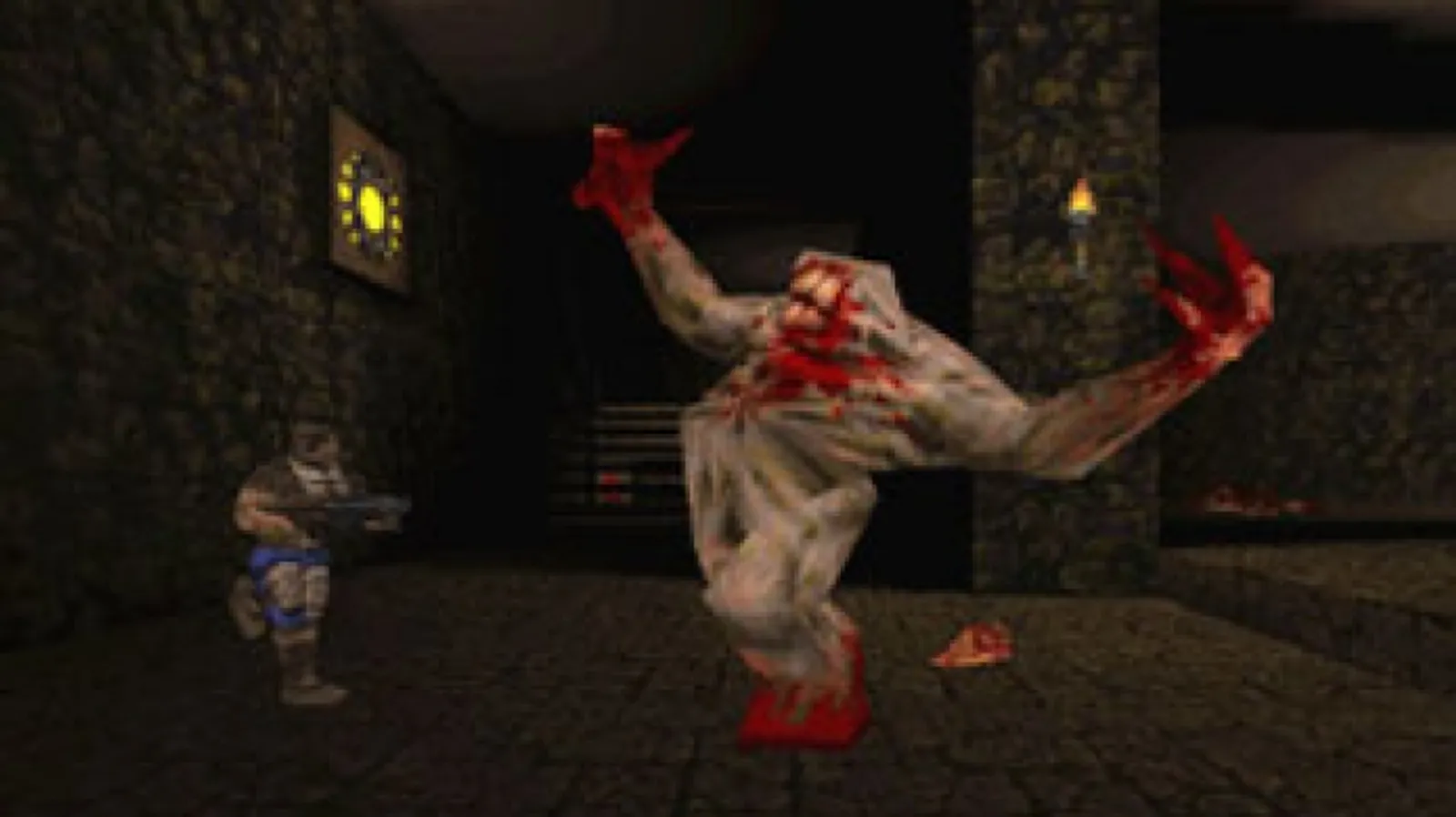
The first second thing I ever did with my very first Internet connection was to attempt to download the Quake demo. Quake had not been
released yet, and it was hotly anticipated by Doom lovers like me. The download came in at about 4MB or so, and after a two or three tries
to download it overnight, I finally succeeded.
I unpacked the zip and ran the game. I wanted to love it like I had loved Doom. I wanted Doom but with full 3D spaces and polygonal, texture-mapped enemies.
What I got was a brownish, medievalish, utter borefest.
Was it all bad?
No, it wasn’t all bad. The genuine 3D, multi level environments and proper physics was a huge step forward. It allowed level designers to be a lot more creative, and the player could bounce things like grenades off walls and ceilings. All of this added an entirely new dimension to the gameplay that didn’t do that much for single player, but did cause Quake to explode in popularity for multiplayer. Paired with TCP/IP support out of the box, the rest is history.
The theme
Doom wasn’t known for its story, but it actually did have one. As simple as it was, the theme was clear. Hell has spilled over into a futuristic moon base and you’re the last one standing. Now you have to fight your way out. The aesthetic was a fusion of technology and hellish biohorror, becoming more hell-like as you progressed through the game. At the end of each of the three original acts, you’d even get a few paragraphs of text to move the story along. This was enough. It provided context, and then got out your way to let Doom be the frantic, gory, and fun shooter it was.
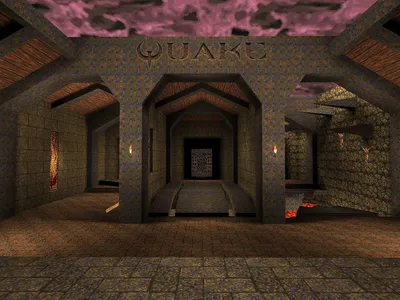
Quake had none of this. You get plopped down into some kind of gothic environment with portals, then enemies ranging from human soldiers, to dogs, to knights in armour, all the way to demonic horrors attack you. There is no self consistency to any of it, except for the consistent use of dull browns almost everywhere. You don’t know why you’re there, why you should care, anything. It makes Doom’s story look like The Count of Monte Cristo.
But it was 1996 and we were young, so we played it anyway.
The weapons
They are all shit, and all shit in similar ways.
For instance, the shotgun is now a 3D model instead of a sprint like in Doom. Wonderful, but it’s 1996 and the sprite looked a shit tonne better when you were actually playing. It also didn’t feel as physical somehow. It felt tinny and hollow. In Doom when you shoot an imp with the shotgun, there is a real feeling of impact despite the sprites.
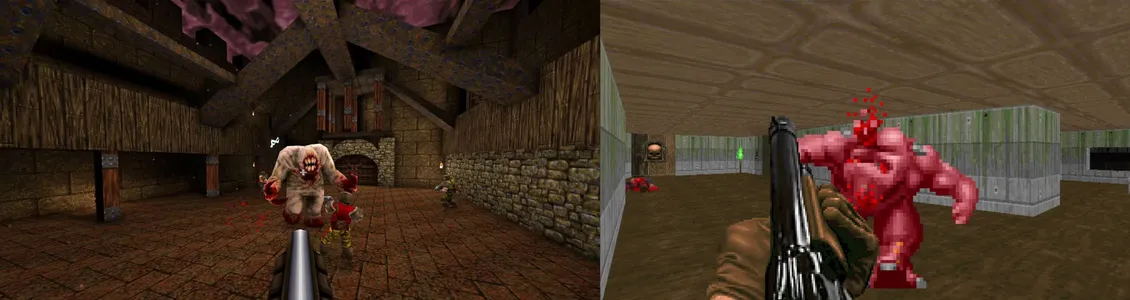
Then there’s a thing called a nailgun. It’s like the chaingun from Doom, except it’s now got a crappy looking 3D model and shoots actual particles. I guess they are supposed to be nails.
The rocket launcher feels like carrying a toilet roll and pretending it’s a rocket launcher.
The enemies
They’re almost all entirely forgettable. The ones that aren’t are just memorably bad.
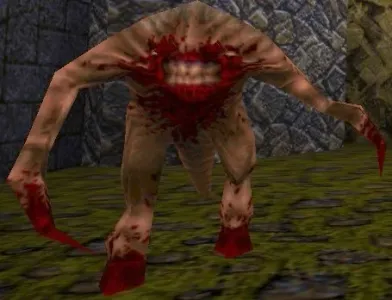
Quake came at the junction from the very best 2.5D that could be achieved, to the first 3D and it showed. Badly. Whereas before an imp would be blasted back 2 metres by a close range shotgun blast, a Quake enemy would slowly keel over through 3D animation keyframes. In later years, this caught up and far surpassed Doom’s simulate physics, but in 1996 it just wasn’t there.
In Doom, if a small enemy was hit by a large enough force at once (say, a rocket), they might be blown apart. This had a very detailed, enemy specific animation. If you looked really closely, it was crudely simulated by playing the animation while moving the enemy at speed away from the blast to suggest they “splattered in that direction”. But it actually looked pretty cool, and felt even better.

In Quake, if you shoot a weak enough enemy in the face, they might gib. This word was popularised by Quake to describe an actor being blown to little bits, or giblets. But when you gibbed an enemy, it was not a hand crafted animation like in Doom, but a semi-random prodedural animation of bits of low-poly model parts being scattered by the physics engine. Exactly like what doesn’t happen when you’re shot at close range by a shotgun. But the gamers seemed to think it was more awesomer and just lapped it right up.

The worst bit though, and this really hurt, was the 3D polygonal enemies were expensive and there was no having 50 of them charging at you at the same time like in Doom. We no longer had hordes. This meant each enemy wanted to be harder to kill to compensate, and it no longer felt like what later came to be termed “Rip and Tear”.
The sound
Much was said about the soundtrack being written by Trent Reznor of Nine Inch Nails. This was in the early CD-ROM era, and Quake took advantage of this to use CD audio tracks for the game music. You could put the Quake CD in your living room stereo and play the music like a normal album. Actually you could also put any other music CD in your computer drive and the game would play that instead of the game music too.
Gone was the slightly cheesy, yet iconic, MIDI soundtrack of Doom. Instead we had some actual artists album, and it felt entirely disconnected from the game. Particularly as the game had no thematic consistency of its own. 30 years on, and I bet you can remember the opening riffs of many Doom levels, but can you remember any of the Quake music at all? I can’t.
The sound effects were no doubt a higher bit rate than Doom’s (this is an assumption!), but they just didn’t sound good. Doom’s chunky shotgun blast and pump action reload sound was now a muffled, generic gunshot noise (without the recoil and reload animation).
With fewer enemies running around, and no music playing because you forgot to put the CD in, it was quite quiet. Doom was claustrophobic. You could hear the enemies lurking just around the corner. All that atmosphere was simply gone.
The gameplay
The previous sections make it pretty obvious that the gameplay sucked. It simply wasn’t fun. Legions of us played it anyway, but in hindsight we were beta testing a new engine. We were playing a tech demo presented as as a game.
And then, something happened that The Ring did not expect. Quake’s release lined up perfectly with the huge upsurge of households getting on the Internet, and it supported TCP/IP out of the box. Although it was a low effort single player game, the game engine enabled a level of tactical multiplayer that had never been possible with Doom. What was actually a massively inferior game to its spiritual predecessor became the seminal online multiplayer FPS game that Quake is now fondly remembered for.
But for this reviewer, who for some reason even as a 17 year old never wanted to play games with strangers on the Internet, it was the number one gaming disappointment of my formative years. So much so that I think I got a little bit depressed, and lost interest in games for some time.
 Cynical Bastard